

QUITE A PROCESS
Doo-Rags, Dust & Milestones

I tried to remember how much of this process I had actually, accurately conveyed, and then I wondered how much was interesting vs. technical vs. downright dry, and then it dawned on me that all the chemicals I have been breathing may have affected both my memory and my ability to convey any such things. (Do let me know!) In the end of that mindful conversation with myself, I thought I would share what it’s like to encase something, in this case a substantial wooden sailing vessel, with fiber reinforced plastic, or FRP, as boatbuilders refer to it.
Quick summary:
Brutal. I’ve been working hard my whole life & this work is BRUTAL.
The rest of the story:
Yours truly is an ivy-wall educated, well-traveled NY/Colorado Chef who had most certainly never heard of FRP even though I had adventured on my fair share of boats. There are a variety of different processes, fiberglass compositions and chemical reactions (resin and hardener) which eventually achieve similar goals. When done properly, fiberglass creates strong, long-lasting, nearly impenetrable protection and structures. Most recreational boats are formed exclusively with FRP. It has proven worthy of respect and if done properly easily maintains its strength and integrity for decades; in our case FRP, in the form of lamination, will protect an antiquated wooden structure along with the newly rebuilt bow section against exterior forces and elements. We made that difficult and costly decision (in time and materials) last fall, extending the duration of our rebuild considerably. I believe, regardless of the controversy surrounding our choice, it has also extended the reach of this vessel in blue water (or anywhere) and most importantly my confidence in her ability to withstand whatever SPARRING WITH MOTHER NATURE might throw her way. Only time will tell.
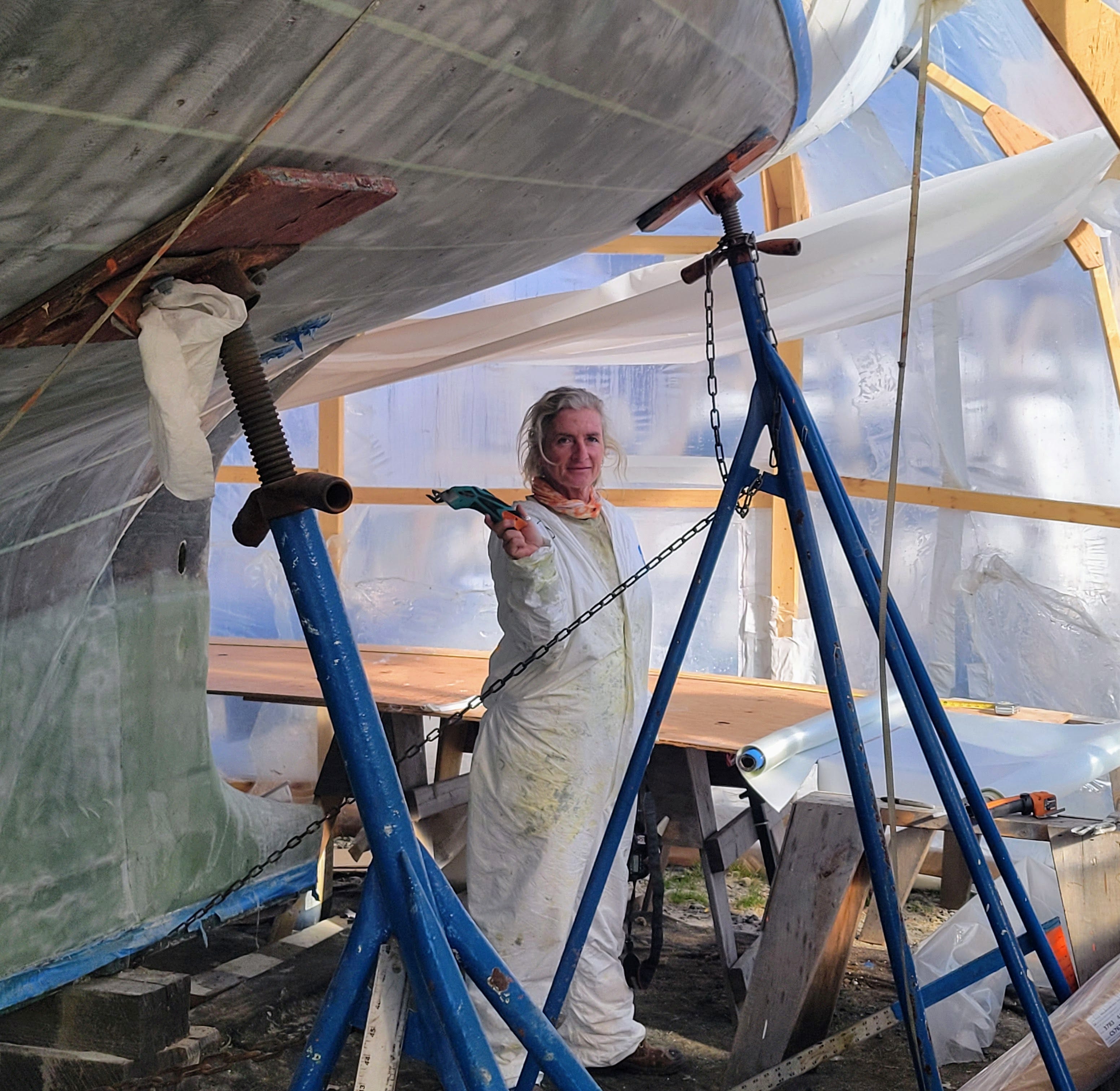
The tremendous majority of STEADFAST’s bottom work is upside down, backwards, toxic, fast-paced, equipment-intensive physical work which I began to share in LAMINATED with an almost-romantic interlude about the nice sea-like color of our resin-coated keel. Well, the shit hit the fan, the romance ran and the endurance, tedium and tenacity proved substantial to say the least. I may be in the best shape of the second half of my life as I type this, although these arthritic fingers are adding a few unplanned keystrokes.
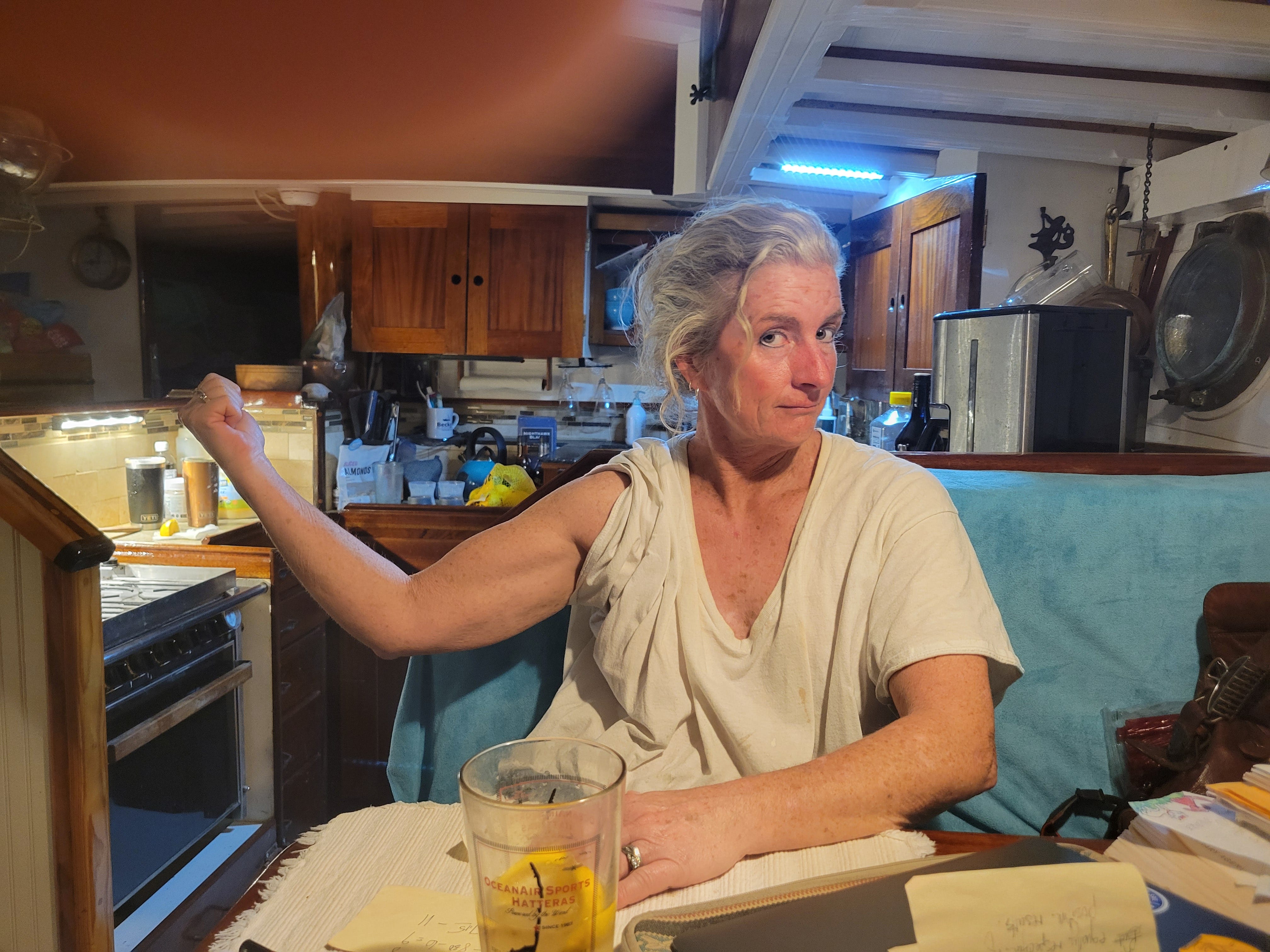
We began to ‘glass’ the hull below waterline the second week of November, working solid ten+ hours days with a few here and there for other responsibilities like filthy loads of laundry. After donning my TYVEK hooded, booted PPE, the hardest concept to grasp was the pure volume of square footage we were applying and the attention to detail that it required; 5,700 square feet, four layers all told, with more needed just prior to our spring launch as she is currently blocked on her keel, making parts of it inaccessible.
While that newly created protective surface is hard, the work is harder. She’s a big boat, fifty-six feet with a full, robust, seven foot keel, sixteen feet at her broadest. Each sheet of satin-weave fiberglass (the most flexible as far as we can ascertain) averaged twelve feet in length and four feet in width weighing over six pounds. That doesn’t sound like much until your arms are stretched far above your head for far too long trying to line it up perfectly with the last time you did it. Each piece averaged about 45 minutes to measure, cut, mix customized ratios of hardener and resin, apply and carefully, crucially extract every last air bubble, which, if left, would negatively effect the adhesion to the previous layer. We have only one hour of working time on each batch of epoxy resin before you MUST begin the next batch and the next layer; every tool, every surface, everything we touch is sticky. Our glove tally so far is over 700 because we must change them between tasks. It’s not my best environmentally friendly work, I know that much.
Using these procedures, we applied two layers on the entire vessel, stapled it with custom-made bronze staples, and added a layer of much lighter peel ply, which is pricey but time and energy saving both because it eliminates the chemical blush that appears as the exothermic reaction culminates and hardens (kicking is the dreaded word when you’ve run out of time...) AND because it reduces much of the grinding required by smoothing and texturing the surface to assure the permanent adhesion of the next layer, whatever that may be. Even with that precaution the grinding takes days.


Steve and long-ago employee and friend Luis España then ground the entire hull with 36 grit, vacuumed the whole tent, wiped the pervasive, invasive fiberglass dust away, only to repeat the ENTIRE process over again (2,800 square feet***) with layers three and four, topped with peel ply. Six weeks work with a couple valiant friends showing up and paid folks who either went above and beyond or failed to return. Importantly, it has to be 60F to cure in a climate where, near the winter solstice, temperatures average around 36F. In order to raise the hull temperature significantly enough, we worked in temperatures kept far above 80F with a kerosene blaster heater in full PPE and kept heating pads on the resin at all times. I hope to never trip over another extension cord.
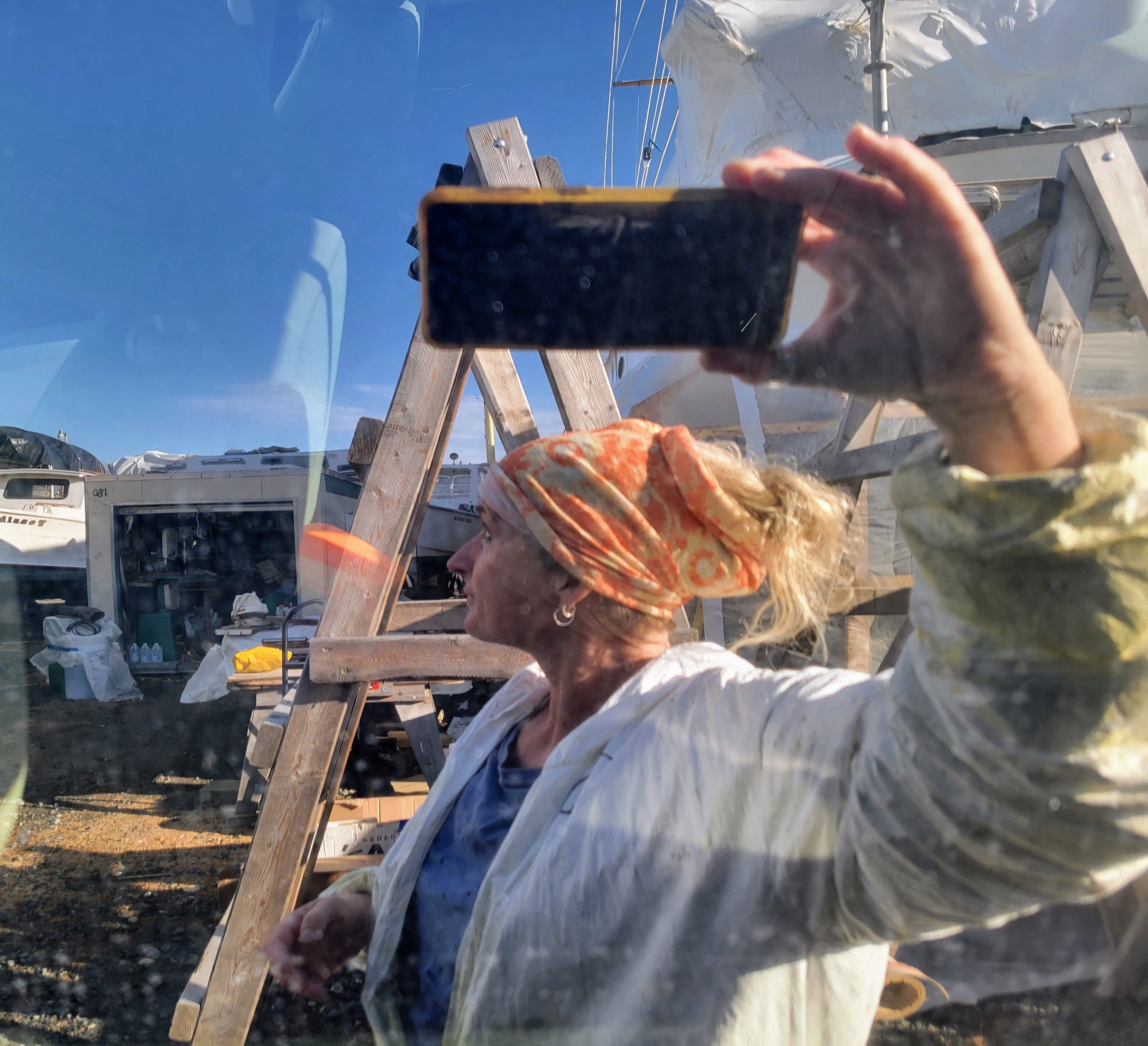
Among the obstacles to doing this job neatly is keeping track of a ceiling when it’s low as well as irregularly curved; I constantly hit my head. After a single, bizarre, evaporative OMG-toxic acetone hair rinse early on (as a reference, nail polish remover is watered-down, scented acetone), I decided a doo-rag was in order. The problem with a doo-rag is that, in order to secure my PPE glasses, sticky fingers touch hairline at temples, well, you get the picture. Out they came. Yeesh.
The MILESTONE? You, fair reader, made it this far! That’s a big one, and I truly appreciate it, but really, for me, the fact that we laid on our last large sheet of fiberglass a couple (long) days BEFORE we thought we would is the biggest accomplishment we could ask for right now. A dusty milestone indeed. I am celebrating that with a little dance! I hope you dance, too, whatever the reason may be. ~J
Do you know the song? It’s a good one; my mom shared it with me before I lost her long ago and it always brings tears, especially, somehow, when times are challenging. I HOPE YOU DANCE —Click it! And then click the RESTACK for all those other poor people who could possibly give a damn about how to lay fiberglass. Those people need some quality, time-killing reading material and here it is.
For a few more technical details on the products we are utilizing, you can peruse:


*** No, I don’t translate US measurements to metric for you because it’s cumbersome and I think most folks get the gist.
HAPPY EVERYTHING! ~J
.....it's a long sweet song Steadfast sings, well into her tenth decade.....of the countless souls who have sailed her decks, gazed at the sea, wind, and weather from her secure rails.....of so many nervously anticipated departures and prayerful relieved returns....of the oft repeated high adventure in between.....so many verses with words, music, harmony known to only a few, she holds them all....the container, the vessel, for so much....it's the refit, the chorus, the refrain, the giving back of her keepers, to extend her life, her spiritual cargo, her mission to carry little more than her own weight; yet, bear a century of experience: realization, actualization, reflection....opportunities for voyages to higher more evanescent realms....now she comes to vibrate this truth.....
Congratulations on reaching another milestone! Glad to have all that fiberglass work done, I'm sure! Oh my! memories! "burgers at that pool hall in Beaufort". Yes! I was there, about 4 years ago, helping a friend with his Catalina 36 delivery from Ft. Lauderdale to Baltimore. The cheeseburgers were delicious, and there was an excellent country/folk band as well! You are going to Galapagos? When will that be? Ask the older guides, captains, Parks personnel,(especially when you're in Puerto Ayora) if they remember the whale research vessel "Odyssey". (white 94' steel ketch. formerly a private yacht, definitely does not look like a research vessel!) We were there 14 months in '93-'94 and back again for 6 months in 2000. Tell them you know Capt. Bob (that's me!). Felipe Cruz might still be at the Galapagos Nat'l Park in Puerto Ayora! Tell him 'Hi' from Capt. Bob! And tell them I was at David Day's 80th birthday party in England this past August! He was a Galapagos guide for 20-30 years, 1980s-2000s. He has Galapagos guide license #2 and was the 'go-to' guide for many documentary filming (BBC, Discovery Channel, PBS, etc.). It was an extraordinary opportunity being there. Because we were there with scientific permits (not as tourists), we got to go places and see things that are forbidden to the tourist boats. (go to 'whale.org', scroll all the way down, and click on "history & legacy" to see a picture of the boat.